Investor onboarding is one of the most operationally challenging areas of private market investing, particularly given the Anti-Money Laundering (AML) and Know Your Customer (KYC) requirements that must be completed before admitting investors. This article examines where AML and KYC checks typically fit within the investor onboarding journey, why the timing and structure of these processes can vary significantly among general partners (GPs), and how differences in internal systems and third-party providers impact onboarding time and complexity. It also considers how digital onboarding tools reduce manual effort, improve transparency, and lower compliance risk.
Effective onboarding extends beyond regulatory requirements. It directly influences fundraising timelines and shapes early expectations for the ongoing relationship between limited partners (LPs) and GPs.
As GPs navigate increasing operational complexity, evolving compliance requirements, and greater competition for capital, onboarding LPs at scale has become more nuanced to manage. While most firms have AML and KYC processes in place, opportunities for improvement often emerge from workflow coordination, system integration, and communication. Addressing these areas can help reduce friction, strengthen LP confidence, and support a smoother fundraising process, particularly in today’s more challenging capital markets.
The onboarding phase is often one of the first sustained interactions between GPs and LPs. A clear, well-orchestrated onboarding experience, supported by timely communication, can set a positive tone for the partnership from the outset. Still, frustrations can arise when investors are being asked to manually complete vast pages of paperwork while experiencing fragmented communications throughout the initial onboarding stage, risking weakening investor trust before a solid relationship can be formed.
Addressing these challenges requires onboarding frameworks that support automated AML and KYC checks and enable workflows to be configured based on investor type, jurisdiction, fund structure, and internal policy requirements. This flexibility is especially valuable when onboarding more complex investor structures, such as special purpose vehicles (SPVs) and fund of funds, which introduce additional documentation and verification requirements.
At the same time, regulatory requirements continue to diverge across jurisdictions. Onboarding processes must therefore support multijurisdictional compliance while remaining consistent enough to be managed efficiently across regions.
Traditional onboarding can be improved to reduce operational strain
Modernizing manual AML/KYC workflows
Over the past decade, digital tools have transformed many areas of financial services. However, investor onboarding in private markets has evolved more gradually. Many GPs still rely on spreadsheets, email, and disconnected portals to manage AML and KYC onboarding requirements.
These manual, laborious methods are not fit for purpose in 2026: slow document collection, labor-intensive identity verification, and inconsistent record-keeping can greatly delay the investor journey.
An illustrative investor journey in private markets
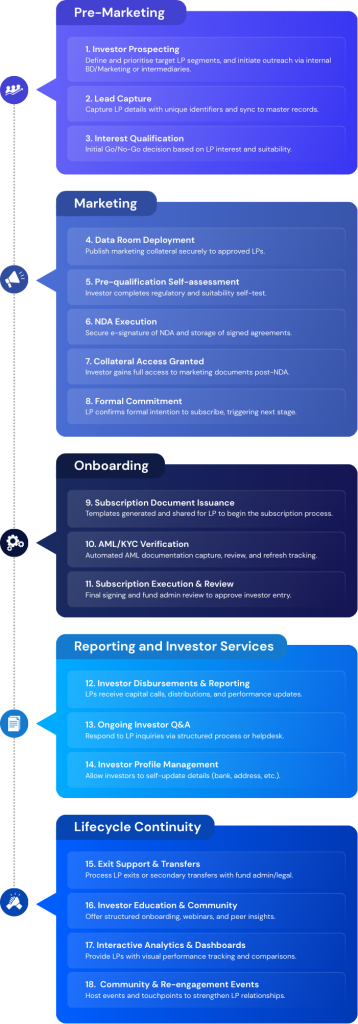
Disclaimer: This infographic has been developed by Bite Stream to illustrate an indicative investor journey in private markets. The steps shown are illustrative only and processes may vary between firms, funds, and jurisdictions. Certain stages — such as investor pre-qualification, NDAs, opt-up or classification forms, investor questionnaires, investor profile creation, or subscription requirements — may differ, occur in a different sequence, or may not apply in all cases.
Subsequently, these delays increase administrative workload and operational costs, negatively impact the investor experience, as LPs are frequently asked to resubmit information or wait for updates with limited visibility into progress. Modern onboarding tools streamline these steps, reducing administrative workload for GPs, fund administrators, and compliance teams, while providing LPs with a clearer, more efficient onboarding experience.
Improving visibility across the onboarding journey
As we mentioned, regulatory processes, such as AML and KYC checks, can be complex and often require a degree of patience before completion. However, one of the most persistent challenges in private markets onboarding is not the duration of these checks, but the limited visibility into their progress.
GPs often have only partial or delayed insight into where prospective investors sit within AML and KYC workflows. At the same time, LPs may receive unclear or duplicate document requests when fund administrators and GPs operate on separate systems or platforms. This lack of coordination can lead to repeated follow-ups, inconsistent communication, causing uncertainty on both sides of the table.
Visibility improves when onboarding workflows are centralized and status-driven. Shared dashboards that display real-time progress, outstanding actions, and upcoming steps enable GPs, fund administrators, and compliance teams to operate from a single source of truth. Automated notifications and clear task ownership further reduce manual follow-ups, while standardized document requests help eliminate duplication and confusion for LPs.
By aligning stakeholders around a transparent, unified onboarding view, firms can significantly reduce administrative effort, improve communication, and reinforce investor confidence at a critical early stage of the relationship.
Supporting configurable, investor-specific workflows
With a plethora of new technological solutions available, coupled with remote working becoming common practice, different areas of the team are frequently using incompatible tech stacks or siloed, rigid systems, leading to a fragmented and slow process. This lack of consistency makes it increasingly difficult to customize workflows based on investor type, geography, or onboarding stage.
In our opinion, private capital managers need configurable onboarding flows that can be adjusted without creating additional administrative work or duplicating already-completed work. For example, risk management will need to begin much sooner than usual when dealing with high-value or international investors. It’s important this happens as a frictionless adjustment rather than as a duplicated process, which only serves to waste everyone’s time.
Why digitally aligned AML and KYC processes add value
Automated AML/KYC checks within a unified platform
The good news is that there are now modern, compatible platforms readily available that support AML and KYC onboarding by automatically collecting documents, running preliminary screenings, and tracking refresh cycles. This automation plays a fundamental role in reducing manual follow-ups, shortening onboarding times, and supporting audit-readiness for regulatory reporting. It also frees up internal teams to focus on strategic, high-value activities such as LP engagement and relationship management.
While this level of automation is widely welcomed by investment firms worldwide, it’s important that a degree of human supervision remains to oversee the process, ensuring that final compliance approval sits with trusted, designated human reviewers. As AI-based technologies continue to improve and encroach more on our day-to-day operations, the importance of balancing automation with credible human oversight to maintain regulatory integrity should not be overlooked.
The latest technology can also provide digital dashboards, offering GPs and LPs full visibility into onboarding progress, outstanding actions, and upcoming steps, greatly improving a well-known friction point for all. This empowers internal teams to benefit from shared oversight, which should closely align investor relations, compliance, and fund administration functions. The end goal will hopefully be a strengthening of the investor experience which helps keep fundraises on track at a time when firms are taking a record amount of time to close new fundraises.
Onboarding as a strategic growth enabler
It’s important to understand that onboarding is not just about box-ticking compliance requirements but should be viewed as the ideal early opportunity to shape a positive investor experience and build long-term, trusted relationships. A smooth, well-structured onboarding process signals operational maturity and professionalism to prospective investors. By enhancing your onboarding process, you tell investors their capital is safe in your hands. On the other hand, a fragmented, slow onboarding process can frustrate LPs, create an unnecessary administrative burden, and even increase the risk of drop-offs, with disastrous long-term consequences for the survival of investment firms.
The GPs who seek to smoothly implement new digital tools that are purpose-built for private markets and offer faster, more transparent, and highly reliable investor onboarding will be the ones that rise to the top for years to come.
We encourage readers to explore Bite Stream’s investor onboarding solution and see how real-time AML and KYC automation fits into a scalable, digital-first fundraising workflow.
Disclaimer: This article is made available by BITE Investments (UK) Limited (“Bite UK”), a company incorporated in the United Kingdom (company registration number 11706620) with its registered office at 28 Ecclestone Square, London SW1V 1NZ. The information contained in this article (the “Information”) is for informational purposes only and may not be relied upon for the purposes of evaluating the merits of investing in any shares, other securities, limited partnership interests or other interests in any funds listed or referred to in the article or for any other purpose. The Information does not constitute an offer to acquire any limited partnership interests, shares or other securities, make any investment or to provide any fund management services or any investment advice of any kind, nor does this article constitute an invitation to invest, directly or indirectly, in any company or collective investment scheme, or to undertake to do so. Reliance on the Information for the purpose of engaging in any investment activity may expose the investor to a significant risk of losing all of the money invested. Nothing in this article is to be construed, and shall not be relied upon as, legal, regulatory, credit, business, tax or accountancy advice. The Information may change and there shall be no obligation on the part of Bite UK to update any of the Information. Data and facts used in this article are derived from sources which are considered to be reliable and have been compiled using Bite UK’s best knowledge. However, Bite UK does not guarantee the correctness of the Information. This article and the Information are strictly confidential and are used exclusively for a limited number of addresses. Reproduction of this article or the dissemination of this article, or the Information, to third parties, is not permitted.

Learn more about how Bite Stream can help you
Discover a solution that suits your needs